
Bet You Didn't Know: 5 Euro-Car Facts That Sound Fake But Are 100% True

Bet You Didn't Know: 5 Euro-Car Facts That Sound Fake But Are 100% True
Grab a coffee and settle in, because we're about to blow up some garage-talk "facts" you've probably repeated as gospel. Euro cars have some of the wildest origin stories in the whole industry — and most owners have no clue. Let's fix that.
1. The BMW Roundel Is Not a Spinning Airplane Propeller
This one gets repeated at every cars-and-coffee meet, and it's wrong. For decades people swore the blue-and-white BMW badge represents a spinning propeller blade — a nod to BMW's early days building aircraft engines.
Reality check: the roundel's blue-and-white quadrants actually come straight from the flag of Bavaria, BMW's home state in Germany. The "spinning propeller" story didn't even show up in BMW's own marketing until the 1920s, years after the badge was designed — it was a clever bit of branding retrofitted onto an existing logo, not the original intent.
Still, if you're repping the roundel life, do it right in the cabin — drop in a BMW M-Sport Style Crystal Shift Knob and let the badge myth stay a myth while your interior gets an actual upgrade.
2. Mercedes-Benz Invented the Crumple Zone — On Purpose, In 1952
Béla Barényi, a Mercedes-Benz engineer, patented the "crumple zone" concept in 1952 — nearly a decade before most of the industry took crash safety seriously. The idea was radical at the time: instead of building an unbreakable rigid shell, design the front and rear of the car to progressively deform and absorb impact energy, protecting a rigid passenger cell in the middle.
Mercedes didn't actually put it into production until the 1959 W111 "Fintail," but the patent sat there for seven years, quietly rewriting the future of automotive safety.
Barényi held over 2,500 patents in his career
He's considered one of the fathers of modern passive safety
The crumple-zone principle is still the backbone of every car's crash structure today
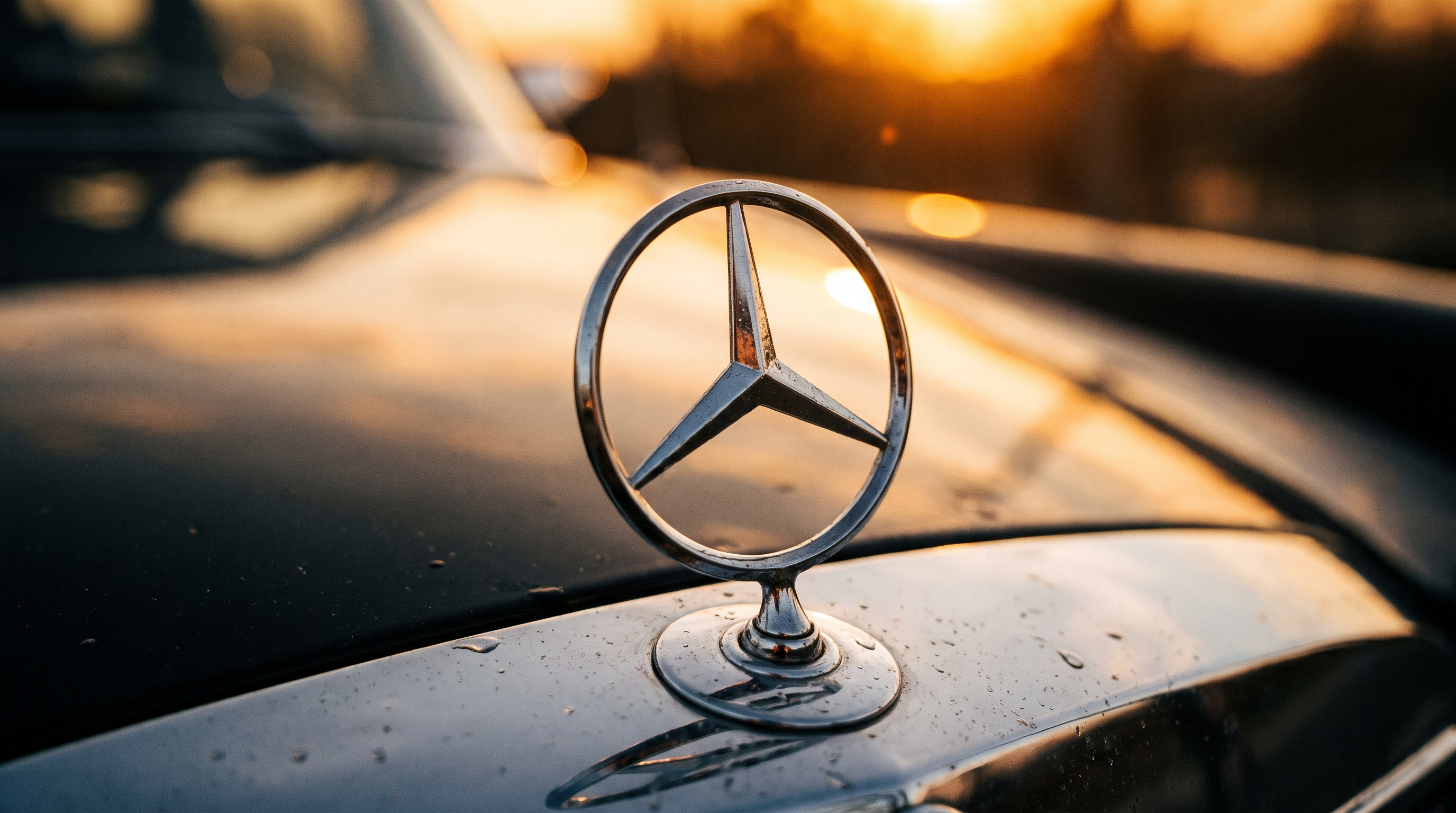
Flying the three-pointed star? Keep it classy under the hood too with the Mercedes-Benz Chrome Hood Star Emblem.
3. Porsche Wanted to Call the 911 the "901" — Peugeot Said No
Porsche originally badged its new flagship sports car the 901. Peugeot stepped in and pointed out it had trademarked every three-digit car name in France with a zero in the middle — and had been doing so since the early 1900s. Rather than fight a French automaker over a number, Porsche simply swapped the zero for a one.
911 stuck. More than six decades and eight generations later, it's arguably the most recognizable model name in the entire automotive world.
4. Saab Used to Build Fighter Jets, Not Cars
SAAB stands for Svenska Aeroplan AB — literally "Swedish Aeroplane Company." Before a single Saab car rolled off a line, the company was building military aircraft, including fighter jets for the Swedish Air Force. That aerospace DNA is exactly why early Saabs had weird, aircraft-inspired engineering quirks — ignition keys between the seats (to keep your knee from going through the dash in a crash), turbocharging adopted early, and bodies built like tiny tanks.
Still rocking a Saab in the garage? Give the cabin a proper nod to that aero heritage with a Saab 9-3 Aero Style Billet Shift Knob.
5. Volvo Invented the Modern Seatbelt — Then Gave It Away for Free
In 1959, Volvo engineer Nils Bohlin patented the three-point seatbelt — the design essentially every car on the road still uses today. Volvo's leadership made an almost unheard-of move: they opened the patent for free use by every other automaker, because they decided saving lives mattered more than protecting the IP.
Estimates credit the three-point belt with saving well over a million lives since it debuted. Not bad for a company better known for wagons.
Facts sourced and cross-checked against reporting from Hagerty.
European cars didn't just build cool machines — they quietly rewrote the rules of safety, naming, and branding for the entire industry. Which one of these facts did you NOT know until today? Drop it in the comments.
Frequently Asked Questions
What do the BMW roundel's blue and white quadrants represent?
The blue and white quadrants of the BMW roundel actually come straight from the flag of Bavaria, BMW's home state in Germany.
Who is considered one of the fathers of modern passive safety?
Béla Barényi, a Mercedes-Benz engineer, is considered one of the fathers of modern passive safety for inventing the crumple zone concept.
Why is Porsche's 911 named what it is?
Porsche originally badged its new flagship sports car the 901. The name was changed to 911 after Peugeot pointed out it had trademarked every three-digit car name in France with a zero in the middle.
What did the early Saab engineers reflect in their design quirks?
Early Saabs had weird, aircraft-inspired engineering quirks, reflecting SAAB's early history of building military aircraft, including fighter jets for the Swedish Air Force.
Comments